Big turbo
or turbo mod?
A turbo upgrade is one of the biggest power moves you can make on a side-by-side, and one of the bigger checks you’ll write. Before you pick one, know the two ways to do it and how to read the numbers people quote.
The two options
Modify it, or replace it.
Most turbo upgrades on side-by-sides are one of two things.
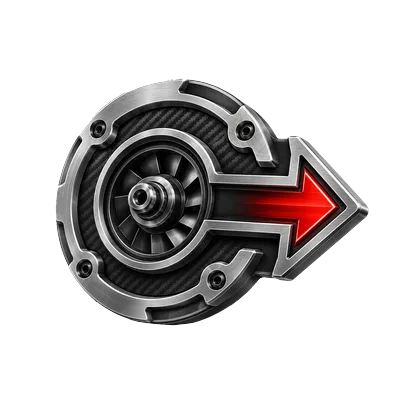
Turbo modification
- Keeps
- Parts of the OEM turbo, most often the compressor wheel and housing.
- Ceiling
- Lower overall power.
- Response
- Comes on boost sooner. The smaller OEM turbine wheel makes boost at lower rpm.
- Lag
- Little to none, with the clutch set up right.
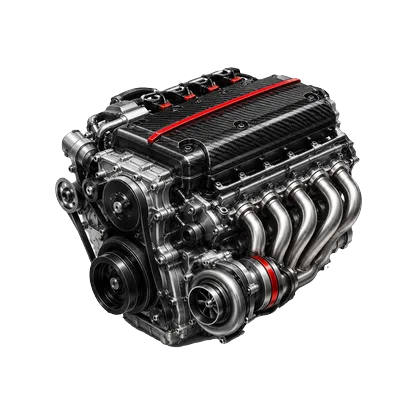
Big turbo swap
- Keeps
- Nothing. It’s a whole new turbocharger, bigger than the factory one.
- Ceiling
- Much higher overall power.
- Response
- The bigger turbine wheel needs more exhaust flowing through it, which means more rpm, before it makes boost.
- Lag
- More of it, and a properly set-up CVT clutch tunes most of it out.
Lag
Why bigger turbos wait.
A turbo is spun by exhaust. The faster the engine turns, the more exhaust it pushes through the turbine, and the harder the turbo spins. That delay between asking for power and the turbo delivering it is lag.
A small turbine wheel needs less exhaust to get going, so it makes boost at lower rpm. A big one needs more, so it wants the engine higher in the rev range before it wakes up.
On a CVT machine, the clutch decides where the engine lives. Set it to hold the engine where the big turbo makes boost and most of the lag goes away. That’s why clutching is part of every big-turbo build. How clutch weights change it →
Reading the numbers
Same claim. Different car.
Power claims make the two options look comparable. On the dyno and in the dunes, they usually aren’t.
Where the number comes from
Most side-by-side tuners use a drum-style chassis dyno, a roller dyno. Some use an engine (crank) dyno or an axle-hub dyno. Everything here is about drum dynos, which report power at the wheels: WHP or RWHP.
Crank power isn’t wheel power
Drum chassis dynos usually show 15–20% less than the manufacturer’s crank rating, the power lost through the drivetrain. A CVT loses more: the rule of thumb is 30%. A Can-Am Maverick X3 Turbo R rated at 172 hp at the crank comes out to about 120 WHP on a drum dyno.
Calibrated isn’t identical
Dynos are calibrated, and they can be close, but the same machine with the same parts on two different dynos usually makes slightly different numbers.
Thin air changes the result
Elevation changes air density, and air density changes what an engine makes. If the ECU asks for more boost than the turbo can make in thin air, you’ll see it as lost power on the dyno. It shows up most when parts are already near their limit.
Crank to wheel
Do the math on any claim.
Slide to a crank horsepower and see what it should look like on a drum dyno.
Rules of thumb, not a dyno sheet. Real loss depends on the machine, the clutch setup and the dyno.
Choosing
Ask yourself four things.
The point isn’t to compare one shop to another. It’s to know the options well enough to make the call for your machine.
- Where do you want power?
Down low and instantly, or a higher ceiling up top? That’s turbo mod versus big turbo.
- Is your clutch set up?
A big turbo without clutching is a big turbo with lag.
- Where do you ride?
Elevation changes what any turbo can make.
- Are the numbers comparable?
Crank or wheel? Which dyno? A 30% CVT loss explains a lot of gaps.
Want a second opinion on your build?
Tell us the machine, how you ride and what you’re after. The shop answers by email.